The Philadelphia Experiment
An Experimental Musical Exploration of Climate Change and Socio-Economic Systems

Lyrics and Liner Notes
The Philadelphia Violent Rain Experiment
[Verse 1]
In Philadelphia, where the skies turn dark,
Violent rainstorms leave their mark,
From Nor’easters fierce to Gulf’s embrace,
Each deluge brings a stronger embrace.
[Bridge]
Hurricane Ida, a tempest grand,
From Category 1 to 4, it ran,
Warm Gulf air, a moisture surge,
Turned Vine Street to a canal’s verge.
[Chorus]
Oh, Philadelphia, in the storm’s embrace,
Tales of rain and fury we face,
From derailed trains to cars swept away,
In the violence of rain, we find dismay.
[Verse 2]
Plymouth Meeting, Washington Crossing too,
Witnessed floods, a tragic brew,
Drenched in rain, the land did yield,
Sinkholes exposed, under Route 202’s shield.
[Bridge]
Tropical Storm Ophelia, a relentless pour,
Soaking streets, flooding shores,
Winter’s grip with rivers’ flow,
January’s fury, a historic blow.
[Chorus]
Oh, Philadelphia, in the storm’s embrace,
Tales of rain and fury we face,
From record March days to winds that roar,
In nature’s rage, we find no shore.
[Outro]
From Delaware’s creeks to Rio’s plight,
In rain’s dance, we fear the night,
The Philadelphia Violent Rain Experiment,
A tale of nature’s relentless lament.
[End]
[Silence]
Science Lesson
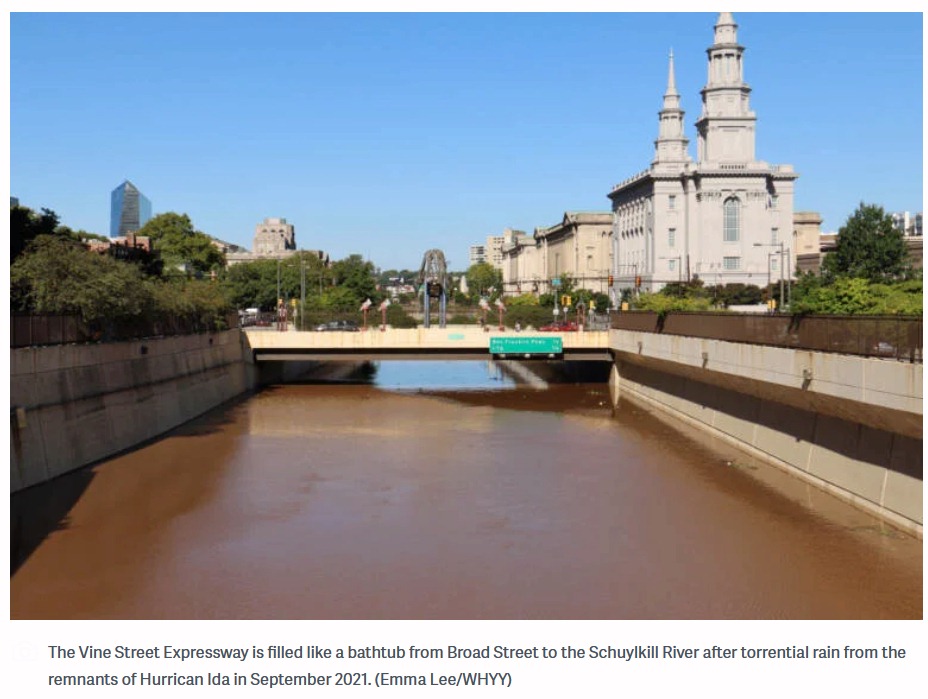
The Greater Philadelphia Area serves as our focal point for studying non-coastal violent rain events. Although situated 78 miles from the nearest coast, Philadelphia has experienced a surge in violent rainstorms since 2021, with each episode yielding more precipitation than the typical monthly average. In addition to enduring Nor’easters and tropical storms from the Southeast, Philadelphia is increasingly subjected to deluges originating from the Gulf of Mexico.
Hurricane Ida in the summer of 2021 is a good example. Because of the 85°F Gulf of Mexico ocean temperature, Ida rapidly gained strength before landfall, jumping from Category 1 to Category 4. Warm air allowed more moisture to be carried as rain. The storm was large enough to pull additional moisture from the Atlantic before moving inland and dumping historic rainfall over Pennsylvania and New York.
The destruction included 5 deaths in the Philadelphia region, 7 tornadoes, record flooding, and hundreds of water rescues. Vine Street Expressway became a canal. As climate change intensifies, the frequency of such extreme flooding events is expected to increase.
The train derailment in Plymouth Meeting, flash flooding in Washington Crossing, sinkholes under Route 202, and the repeated atmospheric river events of late 2023 and early 2024 illustrate the accelerating pattern.
Between December 2023 and January 9, rainfall more than doubled normal levels. The Delaware River reached record heights, and wind gusts exceeded 70 mph.
March 23, 2024 became Philadelphia’s wettest March day on record. At the same time, Brazil’s Rio de Janeiro state experienced catastrophic rainfall, linking regional events to global atmospheric river behavior.
Between April 1–4, 2024, another atmospheric river event brought heavy rainfall and strong winds, resulting in additional fatalities and infrastructure damage.
Philadelphia: Land of Freedom
[Intro]
Dum, de, dum, do, dum, de, dum, dum
Dum, de, dum, do, dum, de, dum, dum
[Verse 1]
In the Land of Freedom
The rule of the fool
Is the selfish act
React
React, act, ack, ack, ack, ack
[Bridge]
Dum, de, dum, do, dum, de, dum, dum
Dum, de, dum, do, dum, de, dum, dum
[Chorus]
Time to pass a law
Responsibility for all
That claim the right
See the light?
Alright, right? Right!
[Verse 2]
When you misunderstand: Free Dumb, de, dum, dum
The rule of the fool
Is the selfish act
React
React, act, ack, ack, ack, ack
[Verse 3]
Is it time to succumb to freedom?
The rule of the fool
Is the selfish act
React
React, act, ack, ack, ack, ack
ECONOMICS LESSON
Climate change is primarily driven by the escalation of thermal energy affecting biogeophysical and socio-economic systems. While biogeophysical factors can be studied using math, physics, and historical records, socio-economic systems pose greater challenges due to the unpredictable consequences of human behavior and inexplicable consumer choices, exacerbating tipping points and feedback loops.
Human rights, social responsibility, and climate change are interconnected in several ways:
- Human Rights Impacts: Climate change disproportionately affects marginalized and vulnerable communities, often violating their human rights through displacement, food insecurity, and inadequate access to clean water and sanitation.
- Social Responsibility: Addressing climate change requires collective action. Individuals, businesses, governments, and organizations share responsibility to reduce emissions, invest in renewable energy, support adaptation efforts, and advocate for policy reform.
- Interconnected Systems: Climate change intersects with health, education, employment, and poverty. Addressing it promotes social justice and sustainable development. Ignoring it exacerbates inequality.
- Policy and Governance: Governments have a duty to protect the right to a healthy environment. Social responsibility frameworks can guide climate policy and human rights protection.
In summary, human rights, social responsibility, and climate change are deeply intertwined. Recognizing these interconnections allows societies to work toward a more just and sustainable future.
Discover Over
[Verse 1]
After the clouds pass over, pass over, over
I love to discover, discover over
Blue sky for my eye
Blue sky for my I
Delight in sunlight
[Verse 2]
Once the storm has passed
To discover at last
Blue sky for my eye
Blue sky for my I
Delight in sunlight
[Bridge]
Insight in sight
Insight incite
Incite insight
Insight in sight
[Chorus]
Ohhhh, I see the light
I see the light
Once again
Agin’ my skin
Ohhhh, I love the light
Love delight
[Verse 3]
Having weathered the storm
What did we learn?
Blue sky for my eye
Blue sky for my I
Delight in sunlight
[Outro]
Insight in sight
Insight incite
Incite insight
Insight in sight
[End]
[Silence]
ABOUT THE SONG
This song captures the experience of weathering violent rain, finding solace in the aftermath, and reflecting on lessons learned about climate change and resilience.
[Verse 1] and [Verse 2] evoke relief as storm clouds clear. The blue sky symbolizes renewal and restored balance.
The [Bridge] introduces introspection — “Insight in sight” suggests that crisis generates awareness.
The [Chorus] expresses gratitude for returning light and warmth, symbolizing resilience.
[Verse 3] asks what we learned — reinforcing adaptation, awareness, and growth.
Overall, the song reflects the cycle of disruption and recovery that defines both climate systems and human systems.
When the Levee Breaks
By Memphis Minnie
[Verse 1]
If it keeps on rainin’, levee’s goin’ to break
If it keeps on rainin’, levee’s goin’ to break
And the water gonna come in, have no place to stay
[Verse 2]
Well all last night I sat on the levee and moan
Well all last night I sat on the levee and moan
Thinkin’ ’bout my baby and my happy home
[Chorus]
Now look here mama what am I to do
I ain’t got nobody to tell my troubles to
I works on the levee mama both night and day
I ain’t got nobody, keep the water away
[Verse 3]
Cryin’ won’t help you, prayin’ won’t do no good
When the levee breaks, mama, you got to lose
[Outro]
I’s a mean old levee, cause me to weep and moan
Gonna leave my baby, and my happy home
ABOUT THE SONG AND SCIENCE
Written after the Great Mississippi Flood of 1927, this song memorializes a disaster that submerged 26,000 square miles and displaced hundreds of thousands.
Climate change now threatens the Mississippi Delta through:
- Sea Level Rise — accelerating land loss and saltwater intrusion.
- Increased Flooding — heavier rainfall overwhelming levees.
- Saltwater Intrusion — damaging freshwater supplies and wetlands.
- Habitat Loss — marshes and estuaries disappearing.
- Agricultural Stress — increased crop vulnerability and economic instability.
The song’s historical warning now echoes in modern climate science: when infrastructure meets accelerating hydrology, resilience must evolve or fail.
The Forecast
[Break]
[Bridge]
Drip, drip, drip
Drip, drip, drip
[Verse 1]
It started with a drip, drip
And turned into a trickle
That churned a current forced to rip
All because Man’s earned fickle
[Chorus]
When you choose your destiny
It’s easy to foresee
Comedy and tragedy
Easy to see, e, e
[Bridge]
De de de de
E e e eeeeeeeeeeeeeeeeeeeeeeee
[Break]
[Verse 2]
It started with a teardrop, drip, drip, drop
Then turned into a flow
Churned a current we couldn’t stop
Because Man neglects to know…
Oh, no, no, no
[Verse 3]
Having cried a river of tears
That turned into an ocean
We churned a current of “worse than” fear
All because of where Man’s been
[Break]
[Chorus]
When you choose your destiny
It’s easy to foresee
Comedy and tragedy
Easy to see, e, e
[Outro]
[End]
[Silence]
SCIENCE LESSON
Some areas of the world are now warming so fast, it is becoming more difficult to measure the change from “normal” or average. Jeff Boyne, National Weather Service meteorologist and climatologist, said, “There are climate normals that are updated every 10 to 15 years, because the planet is warming so fast. The ENSO (El Nino-Southern Oscillation) regions are warming so fast that those normals are being updated every 5 years.”
“It’s so far outside anything we’ve seen, it’s almost mind-blowing,” says Walter Meier, who monitors sea-ice with the National Snow and Ice Data Center. “September was, in my professional opinion as a climate scientist, absolutely gobsmackingly bananas,” said Zeke Hausfather, at the Berkeley Earth climate data project.”
* Our climate model uses chaos theory in an attempt to adequately account for humans and forecasts a global average temperature increase that will render much of the world uninhabitable. Everybody has the responsibility not to pollute. There are plenty of things you can do to help save the planet. Stop using fossil fuels. Consume less. Love more. Here is a list of additional actions you can take.
Profits Predict
[Space]
[Intro]
When the levee breaks
The heart aches
When the levee breaks
[Verse 1]
The lunatic is spouting gas
The lunatic is spouting gas
Climate change is his remains
[Bridge]
And if the dam breaks open many years too soon
And if there is no room upon the hill
And if your head explodes with dark forebodings too
[Break]
[Chorus]
And if the cloud bursts thunder in your ear
You shout and no one seems to hear
And if the band you’re in starts playing different tunes
I see you in the ruins
[Space interlude]
[Bridge]
Take from to the water
Take from to the water
Take from to the water
To be chastised
[Break]
[Bridge]
I was wrong
I was wrong same old song
Same old song and dance
Left destiny to chance
Same old song
Done me wrong
Done me wrong
[Outro]
La da de da da de da
Da
La da de da da de da
De
D
La da de da da de da
Da
La da de da da de da
De
D
[End]
[Silence]
SOCIO-ECONOMIC LESSON
This song reflects on the prophetic voices of rock stars, blues, and folk singers who have warned about the impending impacts of climate change.
[Verse 1] portrays a sense of urgency and despair, likening the actions of those who ignore climate change to madness. The reference to “spouting gas” alludes to both literal emissions contributing to climate change and metaphorical rhetoric that denies or downplays its significance.
The [Bridge] paints a picture of a looming disaster, where the breaking of a dam symbolizes the catastrophic consequences of inaction on climate change. The imagery of a bursting dam and exploding heads evokes a sense of imminent danger and foreboding.
The [Chorus] reflects on the frustration of feeling unheard and powerless in the face of climate crisis. The metaphor of a cloud bursting with thunder suggests the overwhelming nature of climate change impacts, while the mention of a band playing different tunes hints at societal indifference or denial.
The [Space interlude] provides a moment of reflection, perhaps symbolizing the vastness and complexity of the climate change issue.
[Bridge] again emphasizes the importance of water, a fundamental element affected by climate change, and suggests a need for repentance or correction.
[Outro] concludes with a sense of resignation and reflection on past mistakes, echoing the sentiment that the same patterns of denial and inaction persist despite the warnings of climate prophets.
Overall, the song paints a haunting portrait of a world on the brink of climate disaster, with echoes of warnings from the past ringing true in the present. It serves as a call to action and a reminder of the urgent need for collective responsibility and change.
Inspired by Memphis Minnie, Kansas Joe McCoy, Pink Floyd, Led Zeppelin, Al Green, The Talking Heads, Aerosmith, Genesis, and others.
Bonus Track
The Philadelphia Spirit Experiment
[Intro]
Yeah, yeah, yeah
[Verse 1]
In the heart of Philadelphia, a vision took flight
Musicians, writers, dreamers, all in the night
A web of creativity, a spirit unbound
The Philadelphia Spirit Experiment, spreading around
[Chorus]
Fed up with the old ways, tired of the same
We’re rewriting the script, changing the game
With research and development, we aim for the stars
Preserving mankind, healing the scars
Yeah, yeah, yeah
[Break]
[Verse 2]
It’s not just about profit, it’s about something more
Putting the kindness back into mankind’s core
A radical approach, rooted in the past
To make our present count, and ensure it will last
[Chorus]
Fed up with the old ways, tired of the same
We’re rewriting the script, changing the game
With research and development, we aim for the stars
Preserving mankind, healing the scars
Yeah, yeah, yeah
[Break]
[Bridge]
Our climate model tells a tale of dire need
A 9-degree rise, a world we can’t feed
But each of us holds power, in our hands
To change the course, and make a stand
[Chorus]
Fed up with the old ways, tired of the same
We’re rewriting the script, changing the game
With research and development, we aim for the stars
Preserving mankind, healing the scars
[Break]
[Bridge]
So come join the experiment, be a part of the flow
Explore the web of ideas, let your spirit grow
Click on PANIC if you need a hand
Together we’ll journey, across the land
[Outro]
Thanks for listening, hope you enjoyed the ride
Now step into the lyon’s den, with joy and pride
Sincerely, C. Moore, philosopher true
Welcome to the Membrane Domain, where dreams come true.
[End]
[Silence]
ABOUT THE SONG
This website was established by a diverse group, including musicians, writers, computer wizards, businessmen, videots, and individuals with a keen interest. We named this collective effort 'The Philadelphia Spirit Experiment."
PHILADELPHIA? Frustrated with outdated systems and unsuccessful attempts to change them, we chose to take action — perhaps in the spirit of our forefathers?
SPIRIT? The aim of the spirit experiment is to leverage R&D (research and development of business/art/science models) to directly contribute to preserving mankind. Can we help reintroduce the “kind” into mankind by replacing formalized formulas? Our goal is to infuse life with spirit.
A RADICAL APPROACH? Our approach draws on past experiences to make the present count for tomorrow — a radical notion, albeit one focused on positive change.
Thank you for your attention. We hope you grasp the essence of our intentions. If you’re ready, enter the Lyon’s Den — the labyrinth of the Membrane Domain.
Sincerely,
C. Moore
Philosopher
Thermal Inertia
[Intro]
Terminal
Thermal
Ya, ya, ya
Inertia
Ya, ya, ya
[Verse 1]
In the depths of the ocean, where the currents flow,
Thermal inertia holds its sway, a steady undertow.
It resists the changes, the heat it does retain,
But in its depths, a story of climate change is lain.
[Chorus]
Thermal inertia, a silent force unseen,
In the dance of the elements, it plays its part serene.
But beneath the surface, a story starts to brew,
As chaos theory whispers of the changes we’ll go through.
[Break]
[Bridge]
Terminal
Thermal
Ya, ya, ya
Inertia
Ya, ya, ya
[Verse 2]
From the tropics to the poles, chaos reigns supreme,
In the intricate web of the Earth’s complex regime.
Small changes in initial conditions, a butterfly takes flight,
And in the blink of an eye, the world is set alight.
[Break]
[Bridge]
Terminal
Thermal
Ya, ya, ya
Inertia
Ya, ya, ya
[Chorus]
Chaos theory, a wild and untamed beast,
In the heart of the climate, it finds its endless feast.
As feedback loops spiral and tipping points draw near,
The future of our planet becomes ever less clear.
[Bridge]
In the clash of thermal inertia and chaos’s embrace,
We find ourselves entangled in a delicate embrace.
For while one seeks stability, the other craves the storm,
And in their dance of contradictions, our fate is slowly born.
Terminal
Thermal
Ya, ya, ya
Inertia
Ya, ya, ya
[Chorus]
Thermal inertia, a silent force unseen,
In the dance of the elements, it plays its part serene.
But beneath the surface, a story starts to brew,
As chaos theory whispers of the changes we’ll go through.
[Outro]
So as we navigate the currents of this ever-changing tide,
Let us heed the lessons that these forces do provide.
For in the balance of thermal inertia and chaos’s grand design,
Lies the fate of our planet, in the hands of humankind.
[Ending]
[Silence]
THE SCIENCE LESSON
Global warming is caused by an increase in thermal energy in the climate system. The Earth is a climate system. Many subsystems make up our climate. Chaos theory emphasizes the complexity and nonlinearity of dynamic systems.
Thermal Inertia: Oceans have a high thermal inertia, meaning they can absorb and store large amounts of heat. This property moderates temperature extremes, influencing atmospheric temperature patterns. Changes in ocean temperatures can, in turn, impact regional and global climate dynamics. Thermal inertia and chaos theory both play significant roles in shaping and understanding climate change.
- Thermal Inertia:
- Thermal inertia refers to the tendency of a substance to resist changes in temperature due to its heat capacity and conductivity.
- In the context of climate change, thermal inertia affects the response of the Earth’s climate system to external forcings, such as greenhouse gas emissions.
- Oceans, for example, have high thermal inertia, meaning they can absorb and store large amounts of heat over long periods. This leads to a delayed response to changes in external factors.
- The thermal inertia of the Earth’s oceans acts as a buffer against rapid temperature changes, moderating the impact of greenhouse gas emissions on surface temperatures.
- However, once heat is absorbed by the oceans, it can be slowly released back into the atmosphere over time, contributing to long-term climate trends and feedback loops.
- Chaos Theory:
- Chaos theory emphasizes the inherent complexity and unpredictability of dynamic systems, such as the Earth’s climate system.
- In the context of climate change, chaos theory highlights the nonlinear interactions between various components of the climate system, including the atmosphere, oceans, ice, and biosphere.
- Small changes in initial conditions can lead to significant and unpredictable outcomes over time, a phenomenon known as sensitive dependence on initial conditions.
- Nonlinear dynamics within the climate system can give rise to emergent behavior, where collective interactions between individual components produce new and often unexpected phenomena.
- Feedback loops, tipping points, and threshold effects are examples of nonlinear dynamics that can amplify the impacts of climate change and lead to abrupt shifts in climate patterns.
- Chaos theory underscores the challenges of accurately predicting the long-term behavior of the climate system, as small uncertainties in initial conditions can magnify over time, leading to divergent outcomes.
In summary, thermal inertia influences the rate and magnitude of temperature changes in response to external forcings, while chaos theory highlights the complex and unpredictable nature of climate dynamics. Together, these concepts contribute to our understanding of climate change and its impacts on regional and global scales.
Teleconnections
[Intro]
Teleconections
Tella, la, la
La, la, la
[Verse 1]
From the depths of the ocean to the skies up high,
Teleconnections weave tales, they never lie.
El Niño, La Niña, whispers in the breeze,
A dance of warming waters, across the seven seas.
[Chorus]
Teleconnections, a global symphony,
From the North Atlantic to the Southern Sea,
El Niño’s warming, La Niña’s chill,
In the rhythm of the Earth, they sway at will.
[Break]
Teleconections
Tella, la, la
La, la, la
[Verse 2]
North Atlantic Oscillation, a mighty force,
Shifting winds and pressure, charting a new course.
From Iceland’s Low to the Azores’ might,
Influence felt far and wide, day and night.
[Chorus]
Teleconnections, a global symphony,
From the North Atlantic to the Southern Sea,
El Niño’s warming, La Niña’s chill,
In the rhythm of the Earth, they sway at will.
[Break]
Teleconections
Tella, la, la
La, la, la
[Bridge]
Chaos theory whispers, in the winds it cries,
The Earth’s climate, a tale of tangled ties.
Sensitive to beginnings, small changes wield,
Leading to outcomes, across the battlefield.
[Chorus]
Teleconnections, a global symphony,
From the North Atlantic to the Southern Sea,
El Niño’s warming, La Niña’s chill,
In the rhythm of the Earth, they sway at will.
[Break]
Teleconections
Tella, la, la
La, la, la
[Verse 3]
Emergent behaviors, in the chaos dance,
New patterns form, taking their chance.
Nonlinear dynamics, a tangled skein,
In the web of climate, chaos reigns.
[Chorus]
Teleconnections, a global symphony,
From the North Atlantic to the Southern Sea,
El Niño’s warming, La Niña’s chill,
In the rhythm of the Earth, they sway at will.
[Break]
Teleconections
Tella, la, la
La, la, la
[Outro]
Teleconnections and chaos, a tale untold,
In the heart of climate, their secrets unfold.
From El Niño’s warmth to NAO’s sway,
In the dance of the Earth, they have their say.
Teleconections
Tella, la, la
La, la, la
[End]
[Silence]
THE SCIENCE LESSON
Global warming is caused by an increase in thermal energy in the climate system. The Earth is a climate system. Many subsystems make up our climate. Chaos theory emphasizes the complexity and nonlinearity of dynamic systems. General Circulation Models for the earth climate are nonlinear and teleconnected.
Teleconnections: Chaos theory recognizes the concept of teleconnections, where seemingly unrelated events in one part of the Earth system influence conditions in another. For instance, changes in sea surface temperatures (linked to ocean dynamics) can affect atmospheric circulation patterns, leading to variations in precipitation and temperature on land. Teleconnections and chaos theory play significant roles in understanding and predicting climate change:
- Teleconnections: Teleconnections refer to climate anomalies and patterns that occur over large distances and are often linked to each other. These connections can manifest as recurring climate patterns, such as El Niño and La Niña events, the North Atlantic Oscillation (NAO), and the Southern Oscillation (SO). Teleconnections can influence weather and climate conditions globally, impacting precipitation, temperature, and atmospheric circulation patterns.
- El Niño and La Niña: These are phases of the El Niño-Southern Oscillation (ENSO) phenomenon, characterized by anomalous warming (El Niño) or cooling (La Niña) of sea surface temperatures in the tropical Pacific Ocean. These events can lead to widespread changes in weather patterns worldwide, affecting rainfall, temperatures, and storm activity.
- North Atlantic Oscillation (NAO): The NAO is a climate pattern characterized by changes in atmospheric pressure differences between the Icelandic Low and the Azores High over the North Atlantic Ocean. It influences weather patterns in North America, Europe, and North Africa, impacting temperatures, storm tracks, and precipitation patterns.
- Southern Oscillation (SO): The SO is closely related to ENSO and refers to the atmospheric component of the El Niño-Southern Oscillation system. It influences weather patterns across the globe, particularly in the tropical Pacific region.
- Chaos Theory: Chaos theory emphasizes the inherent complexity and unpredictability of dynamic systems, such as the Earth’s climate system. It recognizes that small changes in initial conditions can lead to significant and unpredictable outcomes over time. In the context of climate change, chaos theory underscores the nonlinear interactions between various components of the climate system, including the atmosphere, oceans, ice, and biosphere.
- Sensitive Dependence on Initial Conditions: Chaos theory highlights the sensitivity of complex systems to initial conditions, where small variations can amplify and lead to divergent outcomes. In the climate system, this sensitivity can manifest as abrupt shifts, tipping points, and feedback loops, contributing to nonlinear responses to external forcings like greenhouse gas emissions.
- Emergent Behavior: Complex systems exhibit emergent behavior, where collective interactions between individual components give rise to new and often unpredictable phenomena. Climate change can lead to emergent properties such as extreme weather events, shifts in climate regimes, and changes in ecosystem dynamics.
- Nonlinear Dynamics: Climate systems often exhibit nonlinear dynamics, meaning that changes in one component can trigger nonlinear responses in other parts of the system. This complexity makes it challenging to accurately model and predict the long-term impacts of climate change.
Overall, teleconnections and chaos theory provide valuable frameworks for understanding the interconnected nature of climate change and its impacts on regional and global scales. By incorporating these concepts into climate modeling and research, scientists can improve our understanding of climate dynamics and enhance our ability to mitigate and adapt to ongoing climate change.
Ohm Om
[Intro]
[Bridge]
Ohm, ohm, ohm
Less resistance
Go the distance
Know the difference
Energy synergy
Om, Om, Om
Aum, Aum, Aum
[Verse 1]
Get ready
Hold steady
The wind starts to blow
Already
Quite deadly
Oh, oh, oh…
… oh, oh, no
[Chorus]
Trees torn from limb to limb
Airborne
Better ask himmmm…
To come down off his throne
And take care back at home
[Break]
[Bridge]
Ohm, ohm, ohm
Less resistance
Go the distance
Know the difference
Energy synergy
Om, Om, Om
Aum, Aum, Aum
[Break]
[Verse 2]
Get ready
Hold steady
The cracks start to show
Already
Quite deadly
Oh, oh, oh…
… oh, oh, no
[Verse 3]
Get ready
Old steady
It’s time for us to go
Already
Quite deadly
Oh, oh, oh…
… oh, oh, no
[Chorus]
Trees torn from limb to limb
Airborne
Better ask himmmm…
To come down off his throne
And take care back at home
[Break]
[Bridge]
Ohm, ohm, ohm
Less resistance
Go the distance
Know the difference
Energy synergy
Om, Om, Om
Aum, Aum, Aum
[Chorus]
Trees torn from limb to limb
Airborne
Better ask himmmm…
To come down off his throne
And take care back at home
[Outro]
Ohm, ohm, ohm
Less resistance
The difference
Energy synergy
Om, Om, Om
Om, Om, Om
Ooooooooooooooooooooo
[Ending]
[Silence]
ABOUT THE SCIENCE
Ohm is the SI unit of electrical resistance, representing the measure of opposition to the flow of electric current within a circuit. It quantifies the resistance of a material or component when an electrical potential difference of one volt is applied across it, resulting in the passage of one ampere of current.
“Ohm Om” serves as a poignant metaphor for humanity’s resistance to adapting to climate change. The repetition of “Ohm” and “Om” echoes the meditative chant, suggesting a call for inner peace and harmony amidst turmoil.
In the song, the wind symbolizes the force of climate change, gradually intensifying and becoming more destructive. Despite the warning signs, there’s a reluctance to acknowledge the impending danger. The repetition of “Get ready, hold steady” underscores a sense of preparation and resilience, yet there’s a growing realization of the severity of the situation (“Already, quite deadly”).
The imagery of trees being torn limb from limb and the cracks starting to show reflects the visible impacts of climate change on the environment. Despite these signs, there’s a reluctance to take action (“Better ask him… to come down off his throne”), perhaps representing the inertia and resistance within society to address the issue.
As the song progresses, there’s a sense of urgency (“It’s time for us to go”), acknowledging the need for decisive action in the face of escalating threats. The repetition of “Ohm, ohm, ohm” and “Less resistance” highlights the need to overcome barriers and embrace change.
Ultimately, “Ohm Om” encourages a shift towards greater awareness, unity, and synergy in confronting the challenges of climate change. It calls for a collective effort to transcend resistance and embrace a more sustainable and harmonious relationship with the natural world.
The Threshold Limit
[Intro]
It’s the moisture for sure
The moisture in your future
Sure, sure, sure
The Threshold Limit
Limit it
Limit it
[Verse 1]
The humidity
Gets the best of me
The moisture in the air
Just ain’t fair
[Bridge]
Once rare
I swear
Humidity
Gets the best of me
[Break]
[Chorus]
A wet bulb throb
The heat is on
And, on, and, on
Beyond the dawn
Behold
The threshold
To the minute limit
If you might
Bring on the night
[Verse 2]
Moisture monster
For sure, for sure
No, it’s not the heat
That has me beat
The moisture in the air
Just ain’t fair
[Bridge]
Once rare
I swear
Humidity
Gets the best of me
[Break]
[Chorus]
A wet bulb throb
The heat is on
And, on, and, on
Beyond the dawn
Behold
The threshold
To the minute limit
If you might
Bring on the night
[Verse 3]
Moisture monster
For sure, for sure
Moisture monster
Have we been duped?
It’s thick as pea soup!
The moisture in the air
Moisture monster
No, it’s not fair
Moisture monster
For sure, for sure
[Bridge]
Once rare
I swear
Humidity
Gets the best of me
[Break]
[Outro]
It’s the moisture for sure
The moisture in your future
Sure, sure, sure
The Threshold Limit
Limit it
Limit it
Behold
The threshold
To the minute limit, it, it, it, it…
[End]
[Silence]
THE SCIENCE LESSON
When the “wet bulb” temperature reaches a temperature too hot for humans to sweat, it is referred to as the “wet-bulb temperature threshold” or simply the “wet-bulb limit.” This limit represents the maximum temperature at which evaporation from a wet surface, such as the skin, can effectively cool the human body through sweating. Beyond this threshold, the body’s ability to regulate its internal temperature becomes severely compromised, posing a significant risk to human health and well-being.
Global warming has inflicted irreversible damage on our environment, a consensus echoed by nearly all scientists. Indeed, climate change poses a profound challenge. Our planet is witnessing conditions that increasingly jeopardize human habitation. The critical question now is whether we can adapt swiftly enough. Humans will experience greater loss and damage to life and quality of life from air pollution, decreasing supply of potable water, extreme weather events, disease, and other adverse health outcomes. The greatest short term climate change risk to human health is deadly humid heat (wet-bulb temperature).
Feedback loops and tipping points are parts of an equation that determine the rate of acceleration in climate change. Triggering these tipping points results in the CO2 stored in nature to be released without the assistance of humans. Though we do not know how much carbon is stored in nature, it would be reasonable to assume that the temperature could be pushed from 3 degrees to 6 degrees above pre-industrial levels. Humans cannot thrive above a rise of 1.5 degrees. Much of the Earth will be uninhabitable if the temperature rises an additional 6 degrees Celsius. If humans also add 3 degrees Celsius, the temperature and humidity will approach a wet-bulb temperature that will not sustain human life.
No Sweat
[Intro]
Woe is me
Me, me, me
Me, my, mine
Think it’s fine
Mine, mine, mine
Oh, my, my, my
[Bridge]
No sweat?
Do you regret
Having made the bet?
[Verse 1]
Honey,
Burning through the money
Feels awful…
Awe full funny
When it comes back to bite ya
Ya, ya, ya
Ya, ya, ya
[Verse 2]
Baby,
Always yes, never maybe
Feels awful…
Awe full crazy
When it comes back to bite ya
Ya, ya, ya
Ya, ya, ya
[Chorus]
Pumping gas?
No sweat!
High speed pass?
No sweat!
Understand
Can’t withstand
No, no, no
No sweat
[Break]
[Verse 3]
Papa, [Mama]
Quit! Say you’re gonna.
Feels awful…
Awe full crazy
When it comes back to bite me
Why me
Now I see
Me, me. me
[Chorus]
Pumping gas?
No sweat!
High speed pass?
No sweat!
Understand
Can’t withstand
No, no, no
No sweat
[Outro]
Woe is me
Me, me, me
Me, my, mine
Think it’s fine
Mine, mine, mine
Oh, my, my, my
[End]
[Silence]
THE SCIENCE LESSON
When the temperature exceeds the wet-bulb temperature threshold, which represents the point at which the air becomes too saturated with moisture for sweat to evaporate effectively, the human body faces significant risks of heat-related illnesses and potentially fatal heatstroke.
Under such conditions, the body’s ability to cool itself through perspiration is severely compromised, leading to a rapid rise in core body temperature. As a result, individuals may experience symptoms such as dizziness, fatigue, rapid heartbeat, nausea, and confusion. Without intervention, heat exhaustion can progress to heatstroke, a life-threatening condition characterized by a core body temperature above 40°C (104°F), accompanied by neurological symptoms such as seizures, delirium, and loss of consciousness. Heatstroke requires immediate medical attention and can be fatal if left untreated.
Exposure to temperatures exceeding the wet-bulb threshold poses a grave risk to human health and highlights the urgent need for effective measures to mitigate and adapt to the impacts of climate change, which can exacerbate extreme heat events and increase the frequency of conditions exceeding this critical threshold.
It's Cold, Cold, Cold
[Intro]
It’s cold, cold, cold
Making it so hot
So bold and old
Saying, “Why not?”
Why?
I, I, I
[Verse 1]
Do you know what it means
Pushing extremes…
… not in your dreams?
For real, real
Reel, reel
[Bridge]
Reeling in the years
Spinning out your fears
Running amuck
Uck, uck, uck
Running amuck
[Break]
Running amuck
Uck, uck, uck
Stuck in a rut
But, but, but
Cracked nut
Running amuck
Uck, uck, uck
[Verse 2]
Have you shattered your dreams
Pushing extremes…
… ruin your scenes?
… ruin your seens?
Know what it means
Pushing extremes…
For real, real
Reel, reel
[Bridge]
Reeling in the years
Spinning out your fears
Running amuck
Uck, uck, uck
Running amuck
[Break]
[Break]
Running amuck
Uck, uck, uck
Stuck in a rut
But, but, but
Cracked nut
Running amuck
Uck, uck, uck
[Outro]
Running amuck
Uck, uck, uck
Running amuck
Running amuck
Uck, uck, uck
Uck, uck, uck
[End]
[Silence]
ABOUT THE SONG
The song “It’s Cold, Cold, Cold” metaphorically depicts the chilly reception often encountered when delivering the urgent message of global warming and climate change.
In the opening lines, “It’s cold, cold, cold, making it so hot,” the contradiction highlights the disbelief or apathy faced when discussing the warming of the planet. Despite the pressing nature of the issue, the response is often dismissive or resistant, as indicated by the repetition of “So bold and old, saying, ‘Why not?'” The question “Why?” emphasizes the frustration and confusion of trying to convey the importance of addressing climate change.
The lyrics delve into the consequences of ignoring the reality of climate change, portraying it as pushing extremes and shattering dreams. The repetition of “reel, reel” and “running amuck” conveys a sense of chaos and disarray, emphasizing the destructive path humanity is on by disregarding the warnings of environmental degradation.
The refrain “Running amuck, uck, uck, uck” underscores the sense of being stuck in a rut, unable to break free from harmful behaviors and attitudes that contribute to climate change. Despite the urgency of the message, there is a sense of frustration and resignation, symbolized by the repetition of “Uck, uck, uck.”
Overall, “It’s Cold, Cold, Cold” serves as a poignant commentary on the challenges of raising awareness about climate change in the face of resistance and indifference, urging listeners to confront the reality of global warming before it’s too late.
Plymouth Meeting (Where the Past Meets the Present)
[Intro]
All we owe
We owe Her
All we Oh!
We owe Her
All we Oh!
We owe
[Verse 1]
In the heart of Plymouth Meeting, where the past meets the present
Lies a tale of revolution, commerce, and the essence
From the birthplace of freedom to the cradle of commerce’s rise
There’s a story of creation, hidden ‘neath the azure skies
[Bridge]
In 1688, on historic ground they tread
Quakers met to forge a nation, where freedom’s flame was spread
But across the way, where shadows start to loom
Lies the genesis of industry, and nature’s impending doom
[Chorus]
Oh Plymouth Meeting, where the limekilns burn so bright
You were once the birthplace of dreams, now shrouded in the night
As the rain falls heavy, and the waters rise high
We’re left to face the consequences, of the past’s silent cry
[Break]
[Bridge]
All we owe
We owe Her
All we Oh!
We owe Her
All we Oh!
We owe
[Verse 2]
From the quarry to the railroad, the echoes still remain
Of a time when progress beckoned, with every passing train
But beneath the tracks, where the earth begins to shake
Lies the truth of our folly, a decision we can’t forsake
[Bridge]
For the limekilns of old, with their fiery breath
Released the carbon’s curse, in the dance of life and death
Now as the storms rage on, and the floods start to rise
We must reckon with our legacy, beneath the darkened skies
[Break]
[Chorus]
Oh Plymouth Meeting, where the limekilns stand tall
You once fueled a revolution, now you’re beckoning our fall
As the waters swallow, and the echoes start to fade
We’re left to ponder the cost, of the choices we have made
[Break]
[Instrumental]
[Bridge]
All we owe
We owe Her
All we Oh!
We owe Her
All we Oh!
We owe
Oh, oh, oh
[Break]
[Verse 3]
So let us heed the warning, in the rain’s relentless pour
And remember Plymouth’s lesson, from the days of yore
For in the face of climate change, we stand at a crossroads now
With the power to alter destiny, if only we’d allow
[Outro]
Oh Plymouth Meeting, may your story be a guide
To the perils of our actions, and the hope we hold inside
For in the shadow of your past, lies a path we must reclaim
To forge a future worthy, of our children’s cherished name
All we owe
We owe Her
All we Oh!
We owe Her
All we Oh!
We owe
Oh, oh, oh
…. ohhhhhhhh
[End]
[Silence]
A SCIENCE EXPERIMENT
Hypothesis: Plymouth Meeting is the cradle of climate change.
The train derailment in Plymouth Meeting (July 17, 2023) and the seven people swept away by flood waters in Washington’s Crossing (July 15, 2023) may have been influenced by the historical legacy of climate-altering activities initiated by our forefathers. During the 1600s and 1700s, the United States played a significant role in global events, including movements for freedom, abolition, revolution, and industrialization. In 1688, the establishment of a limestone quarry and limekilns in Plymouth Meeting, PA, marked a pivotal moment in human-induced global warming.
Limekilns are utilized to produce quicklime by heating limestone to temperatures exceeding 1,650 ℉. Quicklime finds applications in various industries, including agriculture, construction, and manufacturing. Prior to the introduction of limekilns, colonists relied on crushing oyster shells to obtain quicklime, a process that later contributed to funding significant historical events such as the American Revolution and the Underground Railroad.
The decomposition of limestone (CaCO3) into quicklime (CaO) during the production process emits substantial CO2 emissions, both from the combustion of fuel to heat the kiln and from the chemical reaction itself (CaCO3 –> CaO + CO2). Given quicklime’s crucial role in cement production, steel manufacturing, and other sectors, ongoing efforts are focused on reducing the carbon footprint associated with this industrial process.
The deaths and infrastructure damage resulting from these events may reflect the long-term repercussions of the cultural, economic, and environmental practices established in Plymouth Meeting centuries ago. This serves as a reminder of the interconnectedness of past actions and present-day consequences, reinforcing the adage that “what goes around comes around.”
Greater Philly Metro
[Intro]
Philadelphia
Fill a
Fill
Ill, ill, ill
[Verse 1]
In the heart of Philly down,
Where the Delaware flows,
Multifaceted challenges abound,
As the Mother’s wrath grows.
[Pre-Chorus]
Violent rain and hurricanes,
Heavy floods, intense heatwaves,
Nature’s fury takes its toll,
On the streets of Philly, we roll.
[Chorus]
Greater Philly Metro, facing the storm,
From sea level rise to heatwaves warm,
Urban heat islands and floods so deep,
In the face of climate change, we must keep.
Ill, ill, ill
Ill
[Break]
Philadelphia
Fill a
Fill
Ill, ill, ill
[Verse 3]
Socio-economic systems intertwined,
With biogeophysical woes combined,
Human behavior, consumer choices,
Adding layers to our climate voices.
Can we hear here? Still…
Ill, ill, ill
We’ve the will
[Pre-Chorus]
Violent rain and hurricanes,
Heavy floods, intense heatwaves,
Nature’s fury takes its toll,
On the streets of Philly, we roll.
[Chorus]
Greater Philly Metro, facing the storm,
From sea level rise to heatwaves warm,
Urban heat islands and floods so deep,
In the face of climate change, we must keep.
Ill, ill, ill
Ill
[Break]
[Bridge]
Agriculture’s plight, ecosystems sway, way
Shifts in habitat, impacts display, dismay
Public health risks on every hand, hand, hand
In the face of change, we stand. understand
[Chorus]
Greater Philly Metro, facing the storm,
From sea level rise to heatwaves warm,
Urban heat islands and floods so deep,
In the face of climate change, we must keep.
Still, you can get your fill
Of brotherly love
From above:
Phil, Phil, Phil
[Outro]
As infrastructure ages, vulnerabilities show,
But with resilience, we can grow,
Greater Philly Metro, united we’ll be,
Facing climate change, with solidarity.
Still, you can get your fill
Of brotherly love
From above:
Phil, Phil, Phil
[End]
[Silence]
A SCIENCE LESSON
Philly, the Delaware Valley and the Greater Philadelphia Metropolitan Area, are significantly impacted by climate change in various ways:
- Increased Frequency and Intensity of Extreme Weather Events: Violent rain. Climate change has led to an increase in the frequency and intensity of extreme weather events such as hurricanes, heavy rainfall, and heatwaves. These events can result in flash flooding, property damage, infrastructure disruptions, and threats to public safety.
- The Social-Ecological Systems: While biogeophysical factors can be studied using math, physics, and historical records, socio-economic systems pose greater challenges due to the unintended consequences of human behavior and inexplicable consumer choices.
- Sea Level Rise and Coastal Flooding: Rising sea levels due to climate change pose a threat to coastal communities in the Delaware Valley, including parts of Philadelphia and surrounding areas. Coastal flooding can lead to property damage, erosion of shorelines, and saltwater intrusion into freshwater sources.
- Heatwaves and Urban Heat Island Effect: Climate change contributes to more frequent and intense heatwaves, which can exacerbate the urban heat island effect in densely populated areas like Philadelphia. High temperatures increase energy demand for cooling, strain public health systems, and disproportionately impact vulnerable populations such as the elderly and low-income communities.
- Impact on Agriculture and Ecosystems: Climate change affects agricultural productivity and ecosystem health in the Delaware Valley region. Changes in temperature and precipitation patterns can disrupt growing seasons, alter crop yields, and affect water availability for irrigation. Additionally, shifts in habitat suitability can impact wildlife populations and biodiversity.
- Public Health Risks: Climate change can exacerbate public health risks in the Greater Philadelphia area, including heat-related illnesses, respiratory problems from poor air quality, and the spread of vector-borne diseases. Vulnerable populations, such as children, the elderly, and those with pre-existing health conditions, are particularly at risk.
- Infrastructure Vulnerability: Aging infrastructure in the Delaware Valley is vulnerable to the impacts of climate change, including increased flooding, storm surges, and heat-related damage. Addressing these vulnerabilities requires investment in resilient infrastructure and adaptation measures to withstand future climate risks.
Overall, the Delaware Valley and the Greater Philadelphia Metropolitan Area face multifaceted challenges from climate change, underscoring the importance of proactive mitigation and adaptation efforts to build resilience and protect communities, ecosystems, and infrastructure.
City of Brotherly Love
[Intro]
Once again,
Imagine.
Imagine a city…
Engine of empathy
From see to shining see
[Verse 1]
Peace sign: a dove
Fly above
See the city
Of brotherly love
Brotherly love
La, la, la, love!
[Break]
[Verse 2]
Say late to hate
Give ‘er a shove
Bring on the love
Embrace face-to-face
Bring on the love
Brotherly love
La, la, la love
La, la, la love
[Bridge]
La, la, la
La, la, love
La, la, la
La, la, love
La, la, la
La, la, love
[Chorus]
There’s only one way out
One way out!
Share the shout:
One way out!
There’s only one way out
Give hate s shove
Give brotherly love
[Verse 3]
Once again, imagine
A city built on empathy
From sure to shining see
Imagine a city
Of brotherly love
City of Brotherly Love
La, la, la, love
[Break]
[Chorus]
There’s only one way out
One way out!
Share the shout:
One way out!
There’s only one way out
Give hate s shove
Give brotherly love
[Outro]
Share the shout:
One way out!
There’s only one way out
Give hate s shove
Give brotherly love
Love, love, love
[End]
[Silence]
A SOCIAL SCIENCE LESSON
Love, empathy, and understanding are crucial for fighting climate change because they foster connection, cooperation, and collective action. Here’s how each of these qualities contributes:
- Love: Love for the planet, its inhabitants, and future generations motivates individuals to take action to protect the environment. When people develop a deep affection and appreciation for nature, they are more inclined to make sustainable choices and advocate for policies that promote environmental conservation.
- Empathy: Empathy involves understanding and sharing the feelings of others, including those who are most vulnerable to the impacts of climate change. By empathizing with communities disproportionately affected by environmental degradation, individuals are compelled to address the root causes of climate injustice and work towards equitable solutions.
- Understanding: Understanding the complex interconnections between human activities and the environment is essential for effective climate action. Educating oneself about the science of climate change, as well as its social, economic, and political dimensions, enables individuals to make informed decisions and advocate for evidence-based policies.
By cultivating love, empathy, and understanding, individuals can foster a sense of interconnectedness with the natural world and with each other, driving meaningful change towards a more sustainable and resilient future.
We the People
[Intro]
“We the People of the United States,
in Order to form a more perfect Union,
establish Justice, insure domestic Tranquility
Tranquility
Let it be
Tranquility
[Verse 1]
We the People
In order to form a more perfect union,
Over opinion
A reliance on science
[Break]
We the People
[Chorus]
Fact over fiction
A revolution
Revolution
Evolution
Solution
Revolution
Revolutionary
Very
[Verse 2]
We the People
Revolutionary ideas
My dear,
Franklin testified
And, until this day still sanctified:
A penny saved,
A penny earned
Lesson learned
Curb the yearn
To yearn and yearn
[Break]
We the People
[Chorus]
Fact over fiction
A revolution
Revolution
Evolution
Solution
Revolution
Revolutionary
Very
[Bridge]
We the people
The beautiful people
Mother,
Man’s solution
Yearn to learn
Very revolutionary
Very
Equality
Tranquility
[Break]
We the People
[Chorus]
Fact over fiction
A revolution
Revolution
Evolution
Solution
Revolution
Revolutionary
Very
Revolutionary
[Outro]
“We the People of the United States,
in Order to form a more perfect Union,
establish Justice, insure domestic Tranquility
Revolutionary
[End]
ABOUT THE SONG
This song, set against the backdrop of Philadelphia and the imperative of addressing climate change, invokes the spirit of unity, justice, and progress outlined in the preamble to the United States Constitution.
The “We the People” refrain serves as a rallying cry for collective action and emphasizes the importance of coming together to confront the challenges posed by climate change. The repetition of “Tranquility” in the intro and outro suggests a desire for peace and harmony, underscoring the need to safeguard the environment for present and future generations.
In the verses, there is a juxtaposition between reliance on science and the need for revolutionary ideas. This reflects the tension between acknowledging scientific evidence of climate change and the innovation required to address it effectively. References to Benjamin Franklin’s wisdom, such as “A penny saved, a penny earned,” highlight the importance of prudent stewardship and forward-thinking solutions in tackling environmental issues.
The chorus emphasizes the importance of prioritizing facts over fiction and calls for a revolution in mindset and action. It speaks to the urgency of evolving our approach to environmental stewardship and finding innovative solutions to mitigate and adapt to climate change.
The bridge celebrates the diversity and resilience of humanity while advocating for equality and the pursuit of knowledge. It reinforces the idea that addressing climate change requires a collective effort grounded in empathy, understanding, and a commitment to social and environmental justice.
Overall, the song conveys a message of hope, empowerment, and determination in the face of climate change, urging listeners to embrace revolutionary ideas and work towards a more sustainable and equitable future.
[Silence]
The Red, White, and Blue
[Intro]
And the rockets’ red glare
The bombs bursting in air
Gave proof through the night
… dawn’s early light
… last gleaming twilight
On broad stripes, the bright stars
Saw through the perilous fight
[Bridge]
Fight, fight, fight
’till we see the light
[Verse 1]
Are you talking white stripes,
Every other read
To a field so blue
Hearts ring true
Figure what to do
You on blue
What stars do
Do, do, do
[Pre-Chorus]
Do what stars do
Shine
Shine, shine, shine
What stars do
Do, do, do
[Chorus]
Come join me if you’re fielding the blues
If you’re feeling blue,
We’ll figure what to do
You on blue
What stars do
Do, do, do
What stars do
[Break]
[Bridge]
Stars and stripes through the night
Stars and stripes into the light
[Verse 2]
The red, white and blue
Sure looks good on you
Our blues have come due, past due
Do what stars do
Shine
Shine, shine, shine
Shine
[Pre-Chorus]
Do what stars do
Shine
Shine, shine, shine
What stars do
Do, do, do
[Chorus]
Come join me if you’re fielding the blues
If you’re feeling blue,
We’ll figure what to do
You on blue
What stars do
Do, do, do
What stars do
[Break]
[Verse 3]
Old Glory,
How will you go down in history
Will you pave the way
Over sooo yesterday
Sowing seeds to today
[Pre-Chorus]
Do what stars do
Shine
Shine, shine, shine
What stars do
Do, do, do
[Chorus]
Come join me if you’re fielding the blues
If you’re feeling blue,
We’ll figure what to do
You on blue
What stars do
Do, do, do
What stars do
Shine
Shine, shine, shine
What stars do
Shine
[Outro]
Saw through the perilous fight
Fight, fight, fight
’till we saw the light
The light
[End]
[Silence]
ABOUT THE SONG
This song is a poetic tribute to the stars of science and climate science, drawing parallels between their resilience and the enduring symbol of the American flag.
The “rockets’ red glare” and “bombs bursting in air” evoke the imagery of struggle and perseverance, symbolizing the challenges faced in the pursuit of scientific knowledge and the fight against climate change. The reference to “dawn’s early light” and “last gleaming twilight” suggests a journey from darkness to enlightenment, mirroring the quest for understanding and solutions in the realm of science.
In the verses, there is a play on the colors of the American flag – red, white, and blue – representing different aspects of the scientific endeavor. The repetition of “What stars do” emphasizes the idea of shining brightly and guiding others through the darkness, much like the stars in the night sky.
The chorus invites listeners to join in the collective effort to address the challenges of climate change, acknowledging the feelings of despair (“feeling blue”) but also expressing determination to find solutions (“figure what to do”). The refrain “What stars do” reinforces the notion that resilience and perseverance are key qualities in the face of adversity.
The bridge celebrates the enduring spirit of the stars and stripes, suggesting that their light will lead the way through the darkness of uncertainty and doubt. The outro echoes the sentiment of resilience and perseverance, urging listeners to continue the fight until the light of knowledge and understanding shines brightly.
Overall, the song conveys a message of hope, unity, and determination in the face of the challenges posed by climate change, honoring the stars of science who lead the way towards a brighter future.
The Philadelphia Zoo
[Intro]
[Animal]
[Jungle]
Did you
Did you
Did you
Go to the zoo?
Hominidae
Day-ah
Hominidae
Day-ya
[Verse 1]
That’s a whole different animal, Man
Man, oh, man
A different animal, criminal
Ban on Man?
[Verse 2]
That’s a whole different animal, Man
Man, oh, man
A different animal, Subliminal
Sometimes sublime
I’m, I’m, I’m
[Pre-Chorus]
Hominidae
Day-ah
Hominidae
Day-ya
That’s why I ask you, did you
Go to the zoo, did you?
[Break]
[Chorus]
At any rate the prime primate
The carrier behind the barrier
Carrier of All’s fate
The prime primate
Coming to think, going extinct
Overate
Prime primate
[Bridge]
I don’t exaggerate
Ate, ate, ate…
Have you been to the zoo?
Have you?
[Verse 3]
That’s a whole different animal, Man
Man, oh, man
A different animal, Animal
Animal born of man
I am, I am, I am
[Pre-Chorus]
Hominidae
Day-ah
Hominidae
Day-ya
That’s why I ask you, did you
Go to the zoo, did you?
[Break]
[Chorus]
At any rate the prime primate
The carrier behind the barrier
Carrier of All’s fate
The prime primate
Coming to think, going extinct
Overate
Prime primate
[Outro]
Hominidae
Day-ah
Hominidae
Day-ya
Day-O
Day-O
Daylight come and me gotta go home
[End]
[Silence]
A SCIENCE LESSON
Yes, humans are classified as primates. Primates are a group of mammals that include lemurs, monkeys, apes, and humans. Humans belong to the family Hominidae, which also includes great apes such as chimpanzees, gorillas, and orangutans. Within the family Hominidae, humans are classified as the species Homo sapiens.
Humans are often considered the most dangerous animal on the planet due to their unique capacity for causing widespread harm and destruction to the environment, other species, and even to themselves. Here are several reasons why:
- Environmental Impact: Humans have a significant impact on the environment through activities such as deforestation, pollution, habitat destruction, and overexploitation of natural resources. These actions contribute to climate change, loss of biodiversity, and degradation of ecosystems, threatening the stability of the planet’s life-support systems.
- Technology and Weapons: Humans have developed advanced technology and weapons capable of causing massive destruction and loss of life. Nuclear weapons, chemical warfare agents, and other weapons of mass destruction pose existential threats to humanity and the planet as a whole.
- Conflict and Violence: Human history is marked by wars, conflicts, and acts of violence that have resulted in millions of deaths and widespread suffering. The propensity for aggression and conflict is a dark aspect of human nature that has led to countless atrocities throughout history.
- Disease and Pandemics: Humans are susceptible to infectious diseases, and our interconnected global society facilitates the rapid spread of pathogens. Pandemics such as the COVID-19 coronavirus demonstrate how human activities and behavior can exacerbate the spread of disease and endanger public health.
- Overpopulation and Overconsumption: The sheer number of humans on the planet, coupled with high levels of consumption and resource exploitation, strain the Earth’s natural systems beyond their capacity to sustainably support human life. Overpopulation and overconsumption contribute to environmental degradation, resource depletion, and social inequality.
- Indifference and Ignorance: Despite being aware of the consequences of their actions, humans often prioritize short-term gains and convenience over long-term sustainability and ethical considerations. Indifference to environmental and social issues, coupled with ignorance or denial of scientific evidence, hinders efforts to address pressing global challenges.
Overall, humans possess the cognitive abilities and technological prowess to shape the destiny of the planet, for better or for worse. Our actions and decisions have far-reaching consequences, making us both the most powerful and the most dangerous animal on Earth.
Can You Dig It?
[Intro]
Can you dig it?
Dig it
Dig it
What can it hurt, digging in the dirt?
[Verse 1]
In the dirt, beneath our feet
Lies a secret, hidden deep
Carbon captured, in the ground
A silent savior, all around
Going down, down, down
[(Chorus]
In the dirt, in the soil
Lies the power to uncoil
Carbon stored, in its hold
A treasure waiting to unfold
[Break]
What can it hurt, digging in the dirt?
Can you dig it?
Dig it
Dig it
[Verse 2]
But beware, for there’s a tale
Of emissions, methane’s wail
From the soil, it may rise
Adding to our warming skies
Self-demise, realize
[Chorus]
In the dirt, in the soil
Lies the power to uncoil
Carbon stored, in its hold
A treasure waiting to unfold
[Break]
What can it hurt, digging in the dirt?
Can you dig it?
Dig it
Dig it
Piggly, dig, dig
[Bridge]
Feedback, back, back, loops
Feedback loops, in soil’s embrace
Changing primate picks up pace
Water cycles, altered, askew
Soil’s role, vital, so true, true, true
[Break]
What can it hurt, digging in the dirt?
Can you dig it?
Dig it
Dig it
Piggly, dig, dig
[Chorus]
In the dirt, in the soil
Lies the power to uncoil
Carbon stored, in its hold
A treasure waiting to unfold
[Break]
What can it hurt, digging in the dirt?
Can you dig it?
[Outro]
So let’s cherish, this precious land
With sustainable, nurturing hand
For in the dirt, lies the key
To a home, that’s healthy and free
[Ending]
[Silence]
A SCIENCE LESSON
Why might soil be the most important piece of the climate change puzzle?
The potential for systemic climate risk is significant: The most vulnerable states and communities will remain disproportionately impacted by a warming world, exacerbating existing inequities. Research indicates that projected population density will intersect with extreme temperatures exceeding 29°C mean annual temperature (MAT), a condition currently limited to only 0.8% of Earth’s land surface area. Under the medium-high scenario of emissions and population growth, it is projected that by 2070, approximately 2 billion people will inhabit these extremely hot areas. Presently, only 30 million individuals reside in such regions, predominantly within the Sahara Desert and Gulf Coast.
Soil plays a crucial role in the climate change puzzle for several reasons:
- Carbon Storage: Soil is one of the largest reservoirs of carbon on Earth, storing more carbon than the atmosphere and vegetation combined. Healthy soils contain organic matter, such as plant residues and microbial biomass, which sequester carbon from the atmosphere through the process of photosynthesis. Preventing soil degradation and promoting practices that enhance soil carbon sequestration, such as agroforestry and no-till farming, can help mitigate climate change by removing carbon dioxide from the atmosphere.
- Greenhouse Gas Emissions: Soil is also a source of greenhouse gas emissions, particularly carbon dioxide (CO2), methane (CH4), and nitrous oxide (N2O). Activities such as deforestation, agricultural practices, and land use changes can disturb soil carbon stocks and release stored carbon into the atmosphere. Additionally, certain microbial processes in soils produce methane and nitrous oxide, potent greenhouse gases that contribute to global warming. Managing land use and adopting sustainable soil management practices can help reduce emissions from soils and mitigate climate change.
- Feedback loops: Changes in climate can impact soil processes and properties, leading to feedback loops that either amplify or mitigate climate change. For example, warmer temperatures can accelerate the decomposition of organic matter in soils, releasing more carbon dioxide into the atmosphere and further exacerbating global warming. Melting permafrost in polar regions can release large amounts of methane, a powerful greenhouse gas, which can further accelerate climate change. Understanding these feedback mechanisms is essential for predicting future climate change scenarios and developing effective mitigation strategies.
- Water Cycle Regulation: Soil plays a critical role in regulating the water cycle by storing and releasing water, influencing evaporation rates, and affecting precipitation patterns. Changes in land use, such as deforestation or urbanization, can alter soil properties and disrupt the water cycle, leading to changes in regional climate patterns. Healthy soils with high organic matter content have better water retention capacity, which can help mitigate the impacts of droughts and floods associated with climate change.
Overall, soil is a vital component of the Earth’s climate system, influencing both the drivers and impacts of climate change. By adopting sustainable soil management practices and preserving soil health, we can help mitigate climate change, enhance ecosystem resilience, and ensure food security for future generations.
The Schuylkill Meets the Delaware
[Intro]
Take me to the river?
Take me from the river
Take me to the river?
Nooo, far from the water
Nooo, don’t wash me down
Down, down, down
[Verse 1]
Where the School kill meets the Delaware
A story of water, a tale to share
Philadelphia’s heart, where rivers embrace
But tidal floods threaten this sacred place
[Chorus]
Oh, the School kill meets the Delaware
As the floods rise, we’re ever aware
Low-lying city, vulnerable zone
Facing the challenges, we’re not alone
Oh, oh, own
[Break]
Far from the water
Don’t wash me down
Down, down, down
[Verse 2]
Proximity to the Delaware Bay
Brings tidal fluctuations our way
In low-lying zones, flooding creeps, seeps
Rising tides invade while we’re fast asleep
[Chorus]
Oh, the School kill meets the Delaware
As the floods rise, we’re ever aware
Low-lying city, vulnerable zone
Facing the challenges, we’re not alone
Oh, oh, own
[Break]
Take me to the river?
Far from the water
Don’t wash me down
Down, down, down
[Bridge]
Narrowing rivers, a tidal bore
Funneling waters, to our front door
Urbanization, concrete and steel
Impervious surfaces, altering what’s real
What’s the deal…
For real
[Chorus]
Oh, the School kill meets the Delaware
As the floods rise, we’re ever aware
Low-lying city, vulnerable zone
Facing the challenges, we’re not alone
Oh, oh, own
[Break]
Take me to the river?
Far from the water
Don’t wash me down
Down, down, down
[Verse 3]
Climate change, a looming threat
Sea levels rise, we can’t forget
As waters encroach, upon our land
We rise to the challenge, hand in hand
[Chorus]
Oh, the School kill meets the Delaware
As the floods rise, we’re ever aware
Low-lying city, vulnerable zone
Facing the challenges, we’re not alone
Oh, oh, own
[Break]
Take me to the river?
Far from the water
Don’t wash me down
Down, down, down
[Outro]
With resilience and hope, we’ll stand tall
Protecting our city, once and for all
The School lkill meets the Delaware, we’ll fight
Against primal floods, with all our might
[End]
[Silence]
A SCIENCE LESSON
The confluence of the Schuylkill River and the Delaware River in Philadelphia is susceptible to climate change impacts in several ways:
- Sea Level Rise: The area is at risk of increased flooding due to sea level rise, which can result from the melting of polar ice caps and thermal expansion of ocean waters. Rising sea levels can lead to more frequent and severe storm surges, causing flooding along the banks of both rivers and in low-lying areas of Philadelphia.
- Stormwater Management: Climate change is projected to increase the frequency and intensity of extreme weather events, including heavy rainfall and storms. The convergence of the Schuylkill and Delaware Rivers makes the area vulnerable to flash flooding, overwhelmed stormwater systems, and erosion, especially during intense rain events.
- Water Quality: Climate change can affect water quality in both rivers, impacting aquatic ecosystems and public health. Increased temperatures can lead to algal blooms, reduced dissolved oxygen levels, and the proliferation of pathogens in the water, posing risks to aquatic life and recreational activities.
- Infrastructure Vulnerability: Critical infrastructure located near the confluence, such as roads, bridges, and utilities, may be vulnerable to climate change impacts, including flooding, erosion, and damage from extreme weather events. Climate-resilient infrastructure planning and adaptation measures are essential to minimize risks and ensure the resilience of infrastructure systems.
- Ecological Impacts: Climate change can disrupt the ecological balance of the rivers and surrounding habitats, affecting fish migration patterns, wetland ecosystems, and biodiversity. Changes in temperature, precipitation, and water flow regimes can alter habitat suitability and food availability for native species, potentially leading to shifts in species distributions and population dynamics.
Overall, the confluence of the Schuylkill and Delaware Rivers in Philadelphia faces multiple climate change-related challenges, highlighting the importance of proactive adaptation strategies, sustainable water management practices, and collaborative efforts to address climate risks and protect the health and resilience of urban ecosystems
Tidal Flooding
The area where the Schuylkill River meets the Delaware River in Philadelphia is susceptible to tidal flooding due to several factors:
- Proximity to the Delaware Bay: Philadelphia is located near the mouth of the Delaware River, which flows into the Delaware Bay and eventually the Atlantic Ocean. As a result, the city is influenced by tidal fluctuations from the ocean, making it susceptible to tidal flooding during high tide events, especially when combined with storm surges.
- Low-lying Geography: Parts of Philadelphia, including areas near the confluence of the Schuylkill and Delaware Rivers, are situated in low-lying coastal zones that are prone to flooding. These areas may experience inundation from rising tides, particularly during king tides or extreme weather events such as nor’easters or hurricanes.
- Narrowing of Rivers: The confluence of the Schuylkill and Delaware Rivers creates a narrowing of the waterways, which can exacerbate tidal flooding by funneling water and increasing water levels during high tide. This phenomenon is known as a tidal bore, where tidal waters are funneled upstream and cause flooding in areas along the riverbanks.
- Urbanization and Impervious Surfaces: Urban development along the riverside, including the construction of buildings, roads, and other impervious surfaces, can exacerbate tidal flooding by reducing natural flood storage areas and increasing runoff during storms. As a result, water from high tides and storm surges may have limited areas to dissipate, leading to more extensive flooding in urbanized areas.
- Saltwater Intrusion:
- Wildlife: Saltwater intrusion can have significant environmental impacts on the Delaware River and its surrounding ecosystems. Increased salinity levels can harm freshwater species adapted to lower salt concentrations, leading to declines in biodiversity and changes in community composition. Saltwater intrusion can also degrade water quality, affect soil fertility, and damage wetland habitats critical for flood control, nutrient cycling, and wildlife habitat.
- Increased Salinity: The intrusion of saltwater into soil raises its salinity levels, as salt ions (such as sodium and chloride) accumulate. High salinity can inhibit plant growth and reduce crop yields, as many plant species are sensitive to elevated salt levels. Excess salt in the soil can disrupt the osmotic balance within plant roots, making it difficult for them to absorb water and essential nutrients.
- Soil Structure Degradation: High salinity can cause soil particles to disperse and compact, leading to poor soil structure. Compacted soils have reduced porosity and drainage capacity, which can result in waterlogging and decreased oxygen availability for plant roots. Soil compaction also impedes root penetration and restricts root growth, further limiting plant productivity.
- Nutrient Imbalance: Saltwater intrusion can alter the balance of essential nutrients in the soil by displacing beneficial ions and disrupting nutrient cycling processes. For example, high levels of sodium in the soil can interfere with the uptake of potassium, calcium, and magnesium by plants, leading to nutrient deficiencies. Imbalances in soil nutrients can impair plant growth, weaken plant defenses against pests and diseases, and reduce crop quality and yield.
- Toxicity Effects: Some salts present in saltwater, such as sodium chloride, can be toxic to plants when accumulated in high concentrations. Salt toxicity can cause leaf burn, chlorosis (yellowing of leaves), stunted growth, and even plant death. Additionally, salt-tolerant plant species may outcompete native vegetation in saline-affected soils, leading to changes in plant community composition and reduced biodiversity.
- Soil Remediation Challenges: Once soil becomes saline due to saltwater intrusion, remediation efforts can be challenging and costly. Techniques such as leaching, flushing, and soil amendments may be used to reduce soil salinity, but these methods often require significant water resources and time to be effective. In severe cases, saline-affected soils may need to be replaced or managed for non-agricultural purposes, limiting their potential for agricultural production.
Overall, the confluence of the Schuylkill and Delaware Rivers in Philadelphia is vulnerable to tidal flooding due to its coastal location, low-lying geography, urbanization, and the influence of climate change on sea levels and storm intensity. Efforts to mitigate tidal flooding risks may include coastal defense measures, improved stormwater management, land use planning, and climate adaptation strategies.