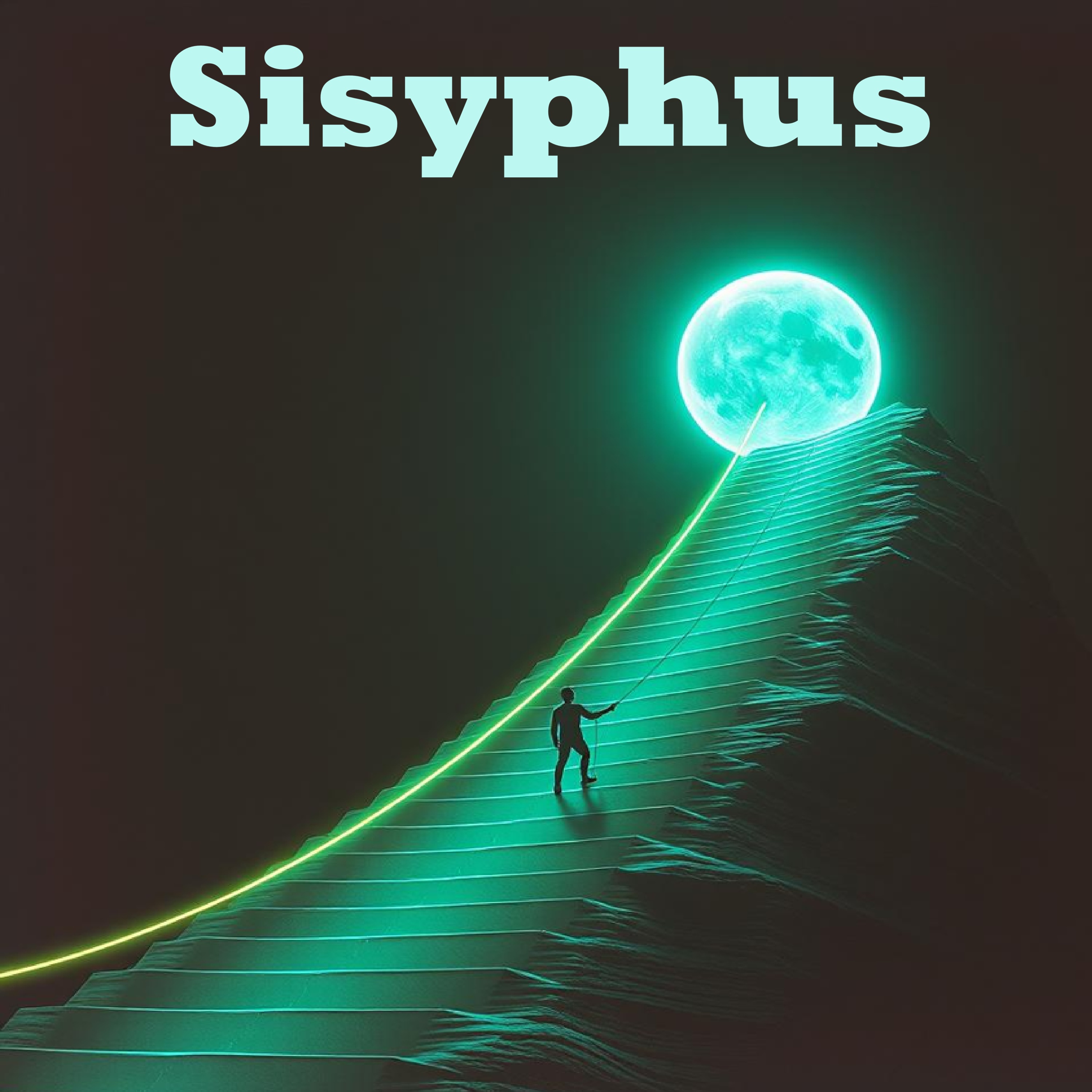
His downfall began, as many do, with power abused. Zeus abducted the nymph Aegina and carried her off to a remote island. Sisyphus saw, calculated, and traded what he knew for advantage. It was not righteousness that moved him, but leverage.
Because of his chronic deceit and bottomless greed, Sisyphus was condemned for eternity to strain against gravity—only to watch his progress thunder back down the slope. Again and again. It was all uphill.
The tragedy wasn’t merely the rock. It was the promise. Every ascent began with a declaration that this time would be different. The incline was “leveling out.” The summit had “never looked closer.” The boulder was rebranded as “tremendous.” The hill was called “historic.” Gravity itself was dismissed as a conspiracy and a hoax.
But physics does not negotiate. Neither does truth. The rock kept rolling.
The punishment was not labor. It was repetition—the grinding cycle of ambition, spectacle, collapse, and denial. Effort confused with achievement. Noise replacing results. An eternity spent mistaking motion for momentum.
It was all uphill. And somehow, the downhill came faster every time.
[Verse 1]
Do you wanna rock
(And roll)
Or rather your rock
(Hold still)
[Bridge]
Freewill?
All the while
(Laborious and futile)
[Refrain]
Sisyphus
(Push, push)
Sisyphus
(Push bein’)
Bein’
(Sisyphean)
[Verse 2]
Come on let’s roll
(Down the hill)
Just let ‘er roll
(Until until)
[Bridge]
Freewill
All the while
(Laborious and futile)
[Refrain]
Sisyphus
(Push, push)
Sisyphus
(Push bein’)
Bein’
(Sisyphean)
[Bridge]
Freewill
All the while
(Laborious and futile)
[Outro]
We will instill
(Freewill)
But will until
(Roll up hill)
ABOUT THE SONG
In Greek mythology, Sisyphus was the cunning founder and first king of Ephyra (now Corinth). He is famously remembered for his eternal punishment in Tartarus: he must push a massive boulder up a steep hill, only for it to roll back down just as it nears the summit, forcing him to repeat the task forever.
The founder and king of Ephyra (now known as Corinth). He reveals Zeus’s abduction of Aegina to the river god Asopus, thereby incurring Zeus’s wrath. His subsequent cheating of death earns him eternal punishment in the underworld, once he dies of old age. The gods forced him to roll an immense boulder up a hill only for it to roll back down every time it neared the top, repeating this action for eternity. Through the classical influence on contemporary culture, tasks that are both laborious and futile are therefore described as Sisyphean
[Verse 1]
About the god’s daughter
(The nymph Aegina)
Perhaps you’d have not, a…
(Done what you aught, a…)
[Bridge]
God Zeus!
(Set your wrath loose)
[Chorus]
The wrath
(For chained death)
Do the math
(Mortal’s total)
[Verse 2]
The reign of divine rules
(Rain on all the fools)
The death wish…
(Of your hubris)
[Bridge]
Such is this
God Zeus!
(Set your wrath loose)
[Chorus]
The wrath
(For chained death)
Do the math
(Mortal’s total)
[Outro]
Such is this
(A bath) in wrath
To infinity
(For all eternity)
God Zeus!
(Ties your own noose)
Zeus’s wrath
(I wouldn’t laugh)
ABOUT THE SONG
Sisyphus reveals Zeus’s abduction of Aegina to the river god Asopus, thereby incurring Zeus’s wrath.
Sisyphus betrayed Zeus by revealing that the king of gods had abducted the nymph Aegina, daughter of the river god Asopus. In exchange for this information, which Sisyphus witnessed, he secured an eternal spring for his city, Corinth. This act of betrayal against Zeus contributed to Sisyphus’, ultimate, eternal punishment.
Sisyphus incurred Zeus’s wrath by violating “divine rules.” Sisyphus acted with extreme hubris, thinking himself smarter than the gods. He not only betrayed Zeus’s secrets but also chained Thanatos (Death), causing a period where no mortals could die.
The Eternal Punishment: Zeus sentenced him to a “Sisyphean task” in Tartarus—a repetitive, pointless, and exhausting labor of rolling a rock up a hill for eternity.
[Verse 1]
Zeus and Epstein on an island
(While in command)
Doing deeds with evil seeds
(Soon to be damned)
[Bridge]
Nymph Aegina
(Enough agita)
[Chorus]
Morals are steadfast
(Throughout time)
Ethic rules forever last
(No doubt… still a crime)
[Verse 2]
Taking underage girls
(For your thrills)
Racking up dues and bills
(Gives the spine chills)
[Bridge]
[Chorus]
[Outro]
Leave those kids alone
(All of us moan)
Leave those kids alone
(In the pedo zone)
ABOUT THE SONG
Zeus abducted the nymph Aegina, daughter of the river god Asopus, by transforming into an eagle (or flame) and carrying her to the island of Oenone. Desiring her, Zeus took her to this secluded location to escape Hera’s jealousy. Aegina gave birth to their son, Aeacus, who later renamed the island Aegina.
[Intro]
Some advice
(… on avarice)
[Verse 1]
The need to exceed
(Desire on fire)
To feed to bleed
(Greed, greed, greed)
[Bridge]
Some advice
(… on avarice)
Cheating immortals and men
(Doing it over and over again)
[Chorus]
Self-aggrandizing
(Wealth vandalizing)
Daft grandstanding
(Stealth corruption)
[Verse 2]
In a mess of excess
(Desire for dire)
To bleed to feed
(Greed, greed, greed)
[Bridge]
[Chorus]
[Bridge]
[Outro]
Cheating mortals and gods
(Doing it over and over again)
… come on… what are your odds
(Of a divine sin?)
ABOUT THE SONG
Sisyphus founded Ephyra (later Corinth) and was known for his extreme cleverness and avarice. As a ruler, he used ruthless, self-aggrandizing methods to boost his wealth, while frequently cheating both mortals and gods. His actions were motivated by a desire to maintain power and wealth, which directly opposed the, often hubristic, authority of the gods. His greed-driven, treacherous nature led to his eternal punishment.
[Intro]
After all (we’ll fall)
… into a deep sleep
(A deep, deep, deep)
… sleep….
[Verse 1]
Thanatos
(… than he knows)
How man comes and goes
(Will your scene be serene)
Thanatos
(… than he knows)
[Bridge]
Do you know what I mean
At the very least
… if I’m gonna cease…
(Bring on the peace)
[Chorus]
After all (we’ll fall)
… into a deep sleep
(A deep, deep, deep)
… sleep….
[Verse 2]
Thanatos
(… the rest he knows)
As man’s to n’ fro’s
(Are deemed seen)
Thanatos
(… head to toes)
[Bridge]
[Chorus]
[Outro]
It’s not a lie
(Everybody’s gonna die)
Sooner or later
A deeper layer
(A deep, deep, deep)
… sleep….
ABOUT THE SONG
In Greek mythology, Thanatos (Ancient Greek: Θάνατος, “Death”) is the personification of death. He is typically distinguished from Hades, who is the ruler of the Underworld, and instead represents the actual transition from life to death.
Key Characteristics and Mythology
Family: He is the son of Nyx (Night) and sometimes Erebus (Darkness). He is the twin brother of Hypnos (Sleep), which reflects the ancient Greek view of death as a permanent sleep.
Role: While his sisters, the Keres, personify violent or painful deaths, Thanatos is often characterized as the bringer of peaceful, non-violent death.
Depiction: In ancient art, he was originally shown as a bearded, winged man or a winged youth carrying a sword. Later Roman depictions often showed him as a beautiful boy (much like Eros) holding an inverted torch, representing a life extinguished.
Myths
Sisyphus: King Sisyphus famously outwitted Thanatos by tricking him into his own shackles. This caused death to cease across the world until the god of war, Ares, intervened to free him.
Heracles: In the play Alcestis by Euripides, the hero Heracles wrestles Thanatos and defeats him to save the life of Alcestis.
[Intro]
Can you demonstrate
(How to participate)
[Verse 1]
Locked in a closet
(Dying to get out)
Death is no closer
(To winning this bout)
[Bridge]
Shout!
(But you can’t get out)
[Chorus]
A demonstration
(Of incarceration)
There’s no fun in winning war
(Any more)
[Bridge]
Can you demonstrate
(How to participate)
[Verse 2]
When wars can’t be won
(It’s no longer fun)
What is the use
(Of being obtuse)
[Bridge]
[Chorus]
[Outro]
Can you demonstrate
(How to participate)
Tackled and shackled
(Can’t figure it out)
’till the god of war
(Said no more)
ABOUT THE SONG
In Greek mythology, King Sisyphus outwitted Thanatos (Death) by asking him to demonstrate how his own shackles worked, subsequently trapping him. This trick, performed to avoid being taken to the underworld, caused a period where no mortals died, forcing Ares to intervene.
The Trick: When Thanatos arrived to take Sisyphus to the Underworld, Sisyphus pretended to be honored but asked to see how the chains functioned first.
The Imprisonment: Thanatos willingly demonstrated, and Sisyphus quickly snapped the shackles shut, trapping him.
Consequences: As a result of Death being locked in a closet/cell, nobody on Earth could die, causing chaos.
Release: The god of war, Ares, angry that his battles were meaningless because people wouldn’t die, intervened and released Thanatos.
Final Fate: Sisyphus was eventually taken to the underworld and punished with the endless, futile task of rolling a boulder up a hill.
[Verse 1]
Cheating death
(May have consequences)
Your health and wealth
(May lose your senses)
[Chorus]
Seven, Eleven
(You can go to heaven)
Snake eyes…
(Everybody dies)
[Bridge]
Heads (I win)
Tails (You lose)
Will you choose
(To play again?)
[Verse 2]
Cheating death
(Is your dream come true?)
Remember Macbeth
(It could happen to you)
[Chorus]
[Bridge]
[Outro]
Go back to “begin”
Heads (I win)
Tails (You lose)
Will you choose
(To play again?)
Now you discover
(Should’ve been a lover)
Eternal hangover
(Game over)
ABOUT THE SONG
Sisyphus cheated death twice in Greek myth: first by tricking Thanatos (Death) into chaining himself, stopping all deaths on Earth, and second by persuading Persephone to let him return from the underworld to scold his wife for improper burial rites, only to refuse to go back. His eternal punishment for these acts of hubris, ordered by Zeus, was to eternally roll a boulder up a hill, only for it to roll back down each time he neared the top.
Macbeth portrays death as the ultimate, inevitable consequence of unchecked ambition and moral corruption, illustrating that violating natural and divine laws leads to madness, guilt, and destruction. Macbeth’s journey from a noble warrior to a tyrannical, isolated murderer culminates in his, and Lady Macbeth’s, deserved downfall, serving as a cautionary tale against greed.
[Verse 1]
Futile labor
(The absurd)
Disregard thy neighbor
(Break your word)
[Bridge]
Humanity’s demanding for understanding
(The reverence of nature’s silence)
[Chorus]
So, you really want to live forever
(Well, we shall see)
… your endeavor
(In immortality)
[Verse 2]
Spending all your years
(In futile tears)
Pushing up your throne
(Sad… and all alone)
[Bridge]
Nothing but skin and bone
Humanity’s demanding for understanding
(The reverence of nature’s silence)
[Chorus]
[Outro]
Until the day you pay
(And cry to die)
Nothing but skin and bone
(Left all alone)
Humanity’s demanding for understanding
(The reverence of nature’s silence)
ABOUT THE SONG
Sisyphus, a cunning Greek king, defied the gods and cheated death twice in his pursuit of escaping mortality. His ultimate, ironic punishment was an eternal, futile task: rolling a boulder up a hill, only for it to roll back down, symbolizing the absurdity of life and the pitfalls of endless, meaningless struggle.
The Pursuit of Immortality and Defiance
* Trickery: Sisyphus was known for his extreme cunning, murdering guests and betraying secrets to defy the gods.
* Cheating Death: He tricked Thanatos (death) into shackles and later deceived Hades to return from the underworld, living for many years before finally dying.
* Hubris: His actions were driven by a desire to master his fate and avoid the natural conclusion of human life.
The Pitfalls: Eternal Struggle and Absurdity
* Futile Labor: As punishment, he was condemned to roll a boulder up a hill for eternity, an act that represents the meaningless, repetitive, and unrewarding nature of life’s struggles.
* The Absurd: Albert Camus described this as the “absurd”—the conflict between humanity’s desire for meaning and the universe’s silent, indifferent nature.
* No Finality: The boulder always falls back, meaning no permanent progress is ever made, mirroring the ultimate futility of human ambition.
Realization and Acceptance
* Consciousness of Fate: During his descent, Sisyphus realizes the hopelessness of his situation, which allows him to become superior to his fate.
* Rebellion: By accepting the futility and continuing to push, Sisyphus rebels against the gods, finding meaning in the struggle itself.
* Camus’ Conclusion: “One must imagine Sisyphus happy,” as the struggle toward the heights is enough to fill a man’s heart.
The myth serves as an allegory for human existence, where the struggle for meaning in a meaningless world is, in itself, the source of freedom and happiness.
[Verse 1]
After all
(She married a mortal)
Grace will fall
(Tartarus outrageous)
[Bridge]
Merope
(Give me enough rope)
To hang myself
(Void my health and wealth)
[Chorus]
The “Lost Pleiad”
(The dimmest star by far)
A hopeless plead
(A myth bizarre)
[Verse 2]
Illumination
(Of your constellation)
Can’t shine that bright
(After gaining insight)
[Bridge]
[Chorus]
[Outro]
Will you concede
Merope
(At the end of my rope)
ABOUT THE SONG
Sisyphus primary wife, Merope, was one of the seven Pleiades, the daughters of the Titan Atlas. She is often said to be the “faint” star in the constellation because she was ashamed of being married to a mortal.
The “Lost Pleiad”
Merope is famously called the “Lost Pleiad” because she is the faintest star in the Pleiades cluster. Two main legends explain her dimness:
Marriage to a Mortal: Unlike her sisters, who all consorted with gods (like Zeus or Poseidon), Merope was the only one to marry a mortal—Sisyphus. She is said to hide her face in heaven out of shame for this “lesser” union.
Shame for Her Husband: Some sources suggest she hid her face because she was mortified by Sisyphus’s legendary crimes and his subsequent eternal punishment in Tartarus.
[Intro]
(This is hubris)
At odds…
(Of living with the gods)
[Verse 1]
To tame Pegasus
(Fly through the sky)
Above all of us
(Gonna give ‘er a try)
[Chorus]
Without a doubt
(Bellerophon will win)
Or he’ll find out
(How mortal’s sin)
[Bridge]
(This is hubris)
At odds…
(Of living with the gods)
[Verse 2]
A false idle
(The golden bridle)
The horse’s tale
(An ultimate fail)
[Chorus]
[Bridge]
[Outro]
Pegasus flew
(Pride grew)
This is hubris’s
(Nemesis)
At odds…
(Of living with the gods)
ABOUT THE SONG
Bellerophon was considered one of the greatest heroes of the generation before Heracles. Like his grandfather Sisyphus, his story is a famous “cautionary tale” about the dangers of hubris (extreme pride).
Origin and the Taming of Pegasus
Double Parentage: He was the son of Eurynome and either King Glaucus of Corinth or the sea god Poseidon.
The Golden Bridle: After failing to catch the winged horse Pegasus, Bellerophon slept in the temple of Athena. He dreamt the goddess gave him a golden bridle, and upon waking, he found the physical object beside him.
The Capture: He used the magical bridle to tame Pegasus while the horse drank from the Fountain of Peirene in Corinth.
[Verse 1]
Lion, goat, serpent
(Snake for a tail)
How to circumvent
(Without a wail)
[Chorus]
Ah, ya (Slaying the chimera)
A fire-breathing monster
(Are you sure you wanna go that far)
Led to dead with lead
[Bridge]
(Fire-breathing monster)
Let it register
[Verse 2]
To avoid searing breath
(Fed with lead)
Mythical depth and breadth
(The moral said)
[Chorus]
[Bridge]
[Outro]
Monster enforcer
[Instrumental, Synth Solo]
Take to the sky
(… and fly)
[Instrumental, Organ Solo, Bass Solo]
ABOUT THE SONG
Slaying the Chimera
Bellerophon was exiled to the court of King Iobates of Lycia, who gave him the “impossible” task of killing the Chimera—a fire-breathing monster with the body of a goat, the head of a lion, and a snake for a tail.
The Chimera (or Khimaira) was one of the most terrifying female monsters in Greek mythology, described by the poet Homer as being of “divine stock, not of men”.
Anatomy and Abilities
While later interpretations sometimes add wings or multiple heads, the classical Greek description of the Chimera is highly specific:
* Physical Hybrid: She possessed the front of a lion, the middle of a she-goat, and the tail of a serpent (or dragon).
* Three Sources of Danger: Most myths describe a goat’s head sprouting from the middle of her back, which was the source of her devastating fire-breathing ability.
* Powers: Along with her searing breath, she had the strength and claws of a lion and a venomous snake tail.
* The Strategy: Because he could fly on Pegasus, Bellerophon avoided the monster’s flames from the air.
* The Kill: He attached a block of lead to his spear and jammed it into the Chimera’s mouth. The creature’s fiery breath melted the lead, which ran down its throat and suffocated it from the inside.
[Intro]
Flow to know
(Betwixt)
… on the River Styx
[Verse]
First time ’round
(Found the middle ground)
Namely…
(Mindlessness aimlessly)
[Bridge]
Passing through
(Asphodel Meadows)
How ’bout you
(Another shadow)
[Verse]
Found I was goin’ ’round
(Round and round and never found)
It was plain I was wondering
(Wandering the Plain of Wandering
[Bridge]
[Verse]
’til I got betwixt
(By the River Styx)
In that space….
(Between a rock n’ a hard place)
[Bridge]
[Outro]
Can’t cross the river
(Can’t seem to deliver)
Stuck in the muck
(Oh, what the funk)
ABOUT THE SONG
Asphodel Meadows: This is the neutral “middle ground” for ordinary souls who were neither exceptionally good nor evil. It is often described as a bleak, grey plain of mindlessness where souls wander aimlessly.
The Plain of Aleion (Plain of Wandering): Specifically for Bellerophon, this was the place on Earth where he fell after his failed flight to Olympus. He spent the rest of his life there blind and alone, essentially caught in a “living death” before he finally passed away.
The River Styx: This is the boundary between the world of the living and the dead. Sisyphus once tricked Persephone on the shores of the Styx into letting him return to life, temporarily existing in that “between” space.
[Intro]
Both of us
(With Tantalus)
Titillating Titans
(On the road to Tartarus)
[Bridge]
The deepest abyss of the Underworld
(Unfurled)
[Refrain]
Come join us…
(With Tantalus)
Titillating Titans
(On the road to Tartarus)
[Bridge]
The deepest abyss of the Underworld
(Unfurled)
Eternally teased
(Never pleased)
[Refrain]
No mess (no fuss)
… join us…
(With Tantalus)
Titillating Titans
(On the road to Tartarus)
In eternity, in well…
(Not quite hell)
[Outro]
Preached
(Never reached)
Every moment
(Every movement)
Torment
(Torment)
Meant
ABOUT THE SONG
Tartarus: This is the deepest abyss of the Underworld, used as a dungeon of torment for the wicked and a prison for the Titans. It is where Sisyphus serves his sentence of rolling the boulder and where Tantalus is eternally teased with food and water he can never reach.
[Intro]
At odds with the gods
(Might take the next flight)
Pegasus to Olympus
[Bridge]
You know
Here we go
[Refrain]
At odds with the gods
(That’s right)
Take the next flight…
(Pegasus to Olympus)
[Bridge]
You know
(Here we go)
If we fly too high….
[Refrain]
At odds with the gods
(That’s right)
Took the last flight…
(Pegasus to Olympus)
[Bridge]
You know
(It was quite a show)
The flight that night….
[Outro]
The overly brash
(Had to crash)
The flight that night….
(Shone the light)
Insight into incite
ABOUT THE SONG
Flight to Olympus: He attempted to ride Pegasus to the peak of Mount Olympus.
The attempted flight to Mount Olympus was the climax of Bellerophon’s life, fueled by a series of impossible victories that transformed his initial desperation into delusions of divinity.
The Path to Hubris
The Deadly Setup: Bellerophon was sent to King Iobates with a sealed letter ordering his execution. Unwilling to kill a guest directly, Iobates instead sent him on “suicide missions” against the fire-breathing Chimera, the warlike Solymoi, and the Amazons.
Unrivaled Success: With the help of a golden bridle from Athena to tame Pegasus, Bellerophon succeeded in every task. Impressed and fearing divine favor, Iobates eventually gave Bellerophon his daughter in marriage and half his kingdom.
The Cognitive Shift: Now a wealthy king and world-renowned hero, Bellerophon’s perspective shifted. He began to believe his feats weren’t just the result of divine aid, but proof that he belonged among the gods themselves.
The Flight of No Return
Bellerophon’s motivation for the flight is often debated in classical texts:
The Quest for Honor: Some versions suggest he simply wanted the gods to personally honor him for his exploits.
Challenging the Gods: In darker interpretations, like the fragments of Euripides’ lost play Bellerophontes, he may have been flying to Olympus to prove the gods didn’t exist because of the injustices he witnessed on Earth.
[Verse 1]
Slaya’ of the Chimera
(On to defeat the Amazon)
Bigger than the cinema
(You go on and on and on)
[Bridge]
After it all
(The downfall)
[Chorus]
Just like grandfather
(Pushed it further and further)
Oh my, grounded by a gadfly
(The horse bucked… you’re….)
Fa, fa, fa
[Verse 2]
They jumped for joy
(When you defeated the Solymoi)
But when hubris got outta check
(You hadda hit the deck)
[Bridge]
[Chorus]
[Bridge]
(Fa, fa, fa)
[Instrumental, Synth Solo]
After it all
(The downfall)
[Outro]
La, la, la
(Fa, fa, fa)
After it all
(The downfall)
ABOUT THE SONG
The Downfall
After succeeding in several other legendary labors (defeating the Amazons and the Solymoi), Bellerophon’s pride grew until he believed he deserved to live among the gods.
Flight to Olympus: He attempted to ride Pegasus to the peak of Mount Olympus.
Zeus’s Retribution: Angered by this arrogance, Zeus sent a gadfly to sting Pegasus. The horse bucked, throwing Bellerophon back to earth.
Tragic End: Bellerophon survived the fall but was blinded or crippled. He spent his remaining days wandering the Aleian Plain alone, avoided by both gods and men until his death.
[Verse 1]
Does your rock roll
(Is it all downhill)
Unfortunate goal
(Not to stop ’till the top)
[Bridge]
An eternity
Spent mistaking motion
… for momentum
[Chorus]
Freewill?
It was all uphill
(The downhill part came faster every time)
Faster and faster
(Toward disaster)
Humanity’s crime (I’mmm….)
[Verse 2]
Does your rock roll
(Despite negativity for gravity)
This is no rock n’ roll stroll
(Repet, repet, repetitivity)
[Bridge]
… stupidity
An eternity
Spent mistaking motion
… for momentum
[Chorus]
[Outro]
Is it still
(All up hill)
Why I ask
(The futile task)
Lost your freewill?
ABOUT THE SONG / MORAL OF THE STORY
Because of his chronic deceit and bottomless greed, Sisyphus was condemned for all eternity to roll a massive boulder up a hill—only to watch it thunder back down again. Over and over. It was all uphill.
The tragedy wasn’t just the rock. It was the promise. Each ascent began with a speech about how this time would be different, how the incline was actually leveling off, how the summit had never looked more attainable. The boulder was rebranded as “tremendous.” The slope was declared “the greatest hill in history.” And gravity, of course, was dismissed as a hoax.
But physics is stubborn. So is truth. The rock kept rolling back.
In The End, the punishment wasn’t the labor. It was the repetition—the endless cycle of hype, strain, collapse, and denial. A masterclass in exertion without progress. An eternity spent mistaking motion for momentum.
It was all uphill. And the downhill part came faster every time.
[Verse 1]
Our situation…
Where to begin?
Human ambition
(Is at it again)
[Chorus]
Is that the goal
Spending the rest of eternity
Wandering in misery
(“Devouring your own soul.”)
[Bridge]
The scoop: (an endless loop)
Loop (loop) loop
Walk the walk
(Push that rock)
[Verse 2]
Make the same mistake
(Twice n’ thrice)
Our final hour
(Seeking power)
[Chorus]
[Bridge]
[Outro]
Jumping through hoops
(and endless loops)
Loop (loop) loop
(Endless loop)
Loop (loop) loop
ABOUT THE SONG
Because of his chronic deceit and greed, Zeus eventually condemned Sisyphus to Tartarus. His punishment—rolling a massive boulder up a hill only for it to roll back down again for all eternity. This is often interpreted as a metaphor for the futility of human ambition and the hollow nature of seeking power for its own sake.
Sisyphus grandson, Bellerophon, fell from grace due to excessive pride and spent the rest of his life wandering in misery and “devouring his own soul.”